What horizontal and vertical SaaS actually mean
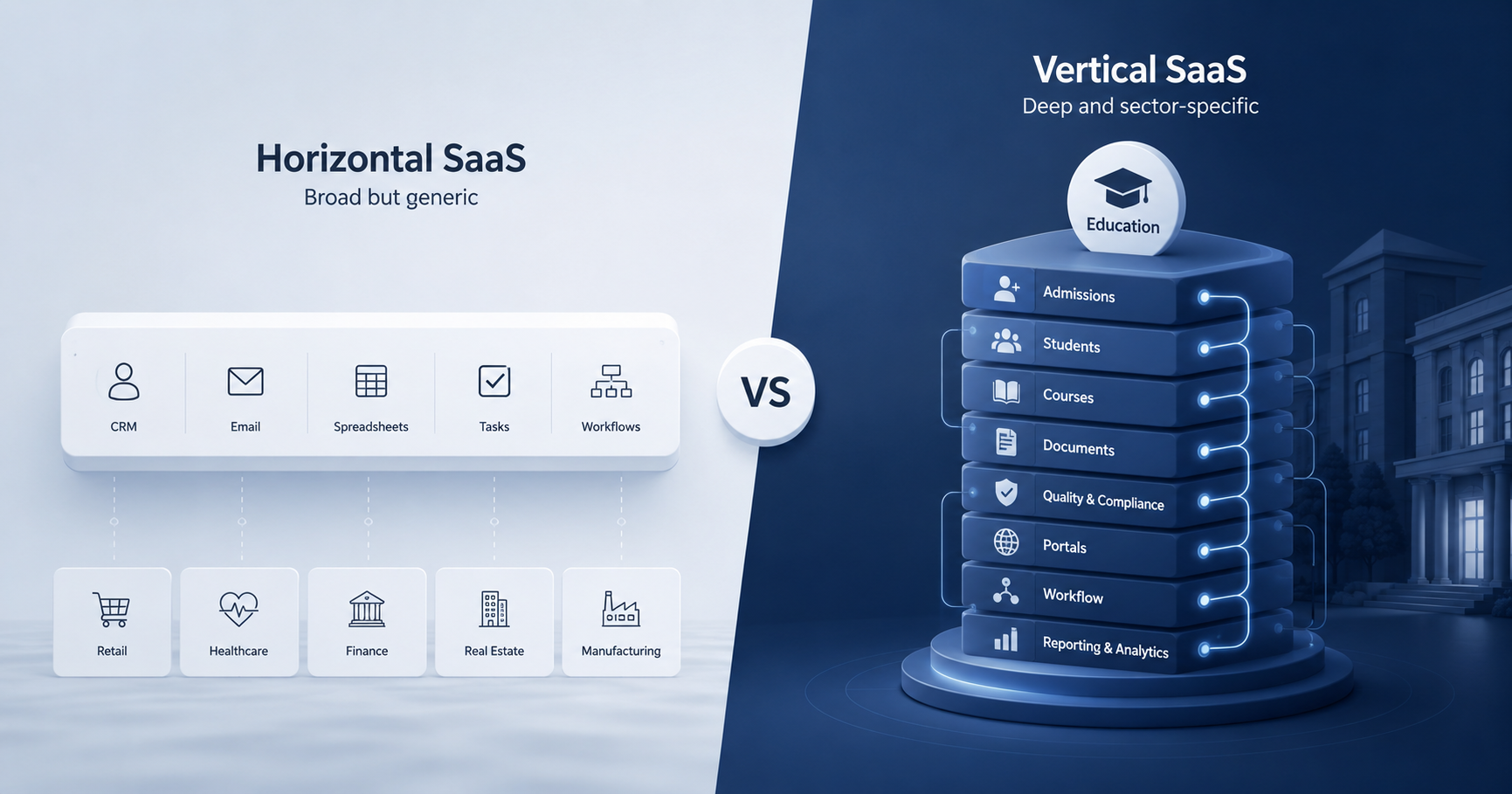
Horizontal SaaS targets a job that exists across every industry — email, spreadsheets, generic CRM, generic project management, generic HR. The product is intentionally broad so the same tool can serve a law firm, a manufacturer and a training centre with the same core building blocks.
Vertical SaaS is designed around one sector. The data model, terminology, workflows, roles, portals and reporting reflect how that industry actually operates. Education platforms model students, cohorts, admissions and quality processes; healthcare platforms model patients, encounters and clinical protocols; field-service platforms model jobs, technicians and assets.
Horizontal SaaS is often enough
Not every organisation needs a sector-specific system. Horizontal SaaS is usually the right answer when workflows are simple and mostly linear, sector-specific requirements are low or informal, you have strong internal integration and configuration capability, low per-seat cost matters more than short time to value, and a large ecosystem of third-party add-ons is important.
Signals your operations have outgrown a generic stack
As soon as operations become sector-specific, generic tools start to strain. Common patterns we see: renamed fields and generic objects pretending to be students, learners, patients, jobs or cases; disconnected tools for CRM, documents, tasks, portals and reporting; duplicated records across systems kept in sync by hand; manual evidence collection for quality, accreditation or audits; weak workflow traceability; compliance and quality processes managed outside the system.
Where each approach wins
Horizontal SaaS wins when the process really is the same across industries, you have engineers to configure, integrate and maintain, a large ecosystem of third-party add-ons matters, and per-seat cost is more important than time to value.
Vertical SaaS wins when your operations have sector-specific rules and records, teams need one connected system, quality/audit/evidence are part of daily work, and you want a shorter path from purchase to real use.
The GestWave approach
GestWave is a modular vertical SaaS ecosystem built by ARP Group Ltd in Malta. It is not a single generic CRM. Instead, GestWave is a family of sector-specific products that share a common operational core — CRM, workflows, documents, portals, permissions, audit and reporting — so teams work in one connected environment rather than a patchwork of disconnected tools.
GestWave Edupro focuses on the operational side of education management: admissions, student records, course administration, documents and quality workflows. GestWave VLE supports online and blended learning delivery. They are distinct products with distinct roles, designed to work together as connected parts of a broader GestWave ecosystem.